Blog Post 8, What my next semester and summer will be like for me.

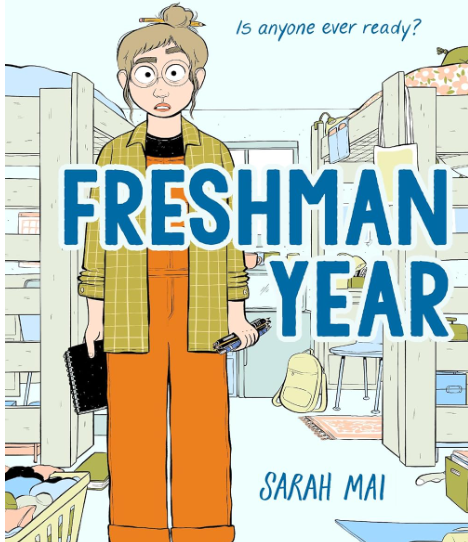
As I approach the end of my first semester, reading Sarah Mai’s “Freshman” gave me a moment to pause and consider how our college experiences align, and where they take different turns. Sarah completed her first full semester and faced some big decisions, like whether to transfer to art school. In the end, she chose to stay, while some of her friends’ changed majors. That’s life: adapt, adjust, and change plans as needed. For me, the path is already clear. I’ve committed to accounting and mapped out the classes I need from now through senior year.

Sarah’s spring break sounded refreshing, rainy, yes, but still a true break. I’m hoping mine will be just as restful. Fall break was anything but relaxing; I was buried in assignments. I’m grateful I got into the classes I needed for spring, but I do hope the homework load lightens up. This semester stretched me, it was intense.

Sarah also took a spontaneous trip to New York with friends, which I admire. That kind of spontaneity gave her the chance to explore the city and spend quality time with her besties. For me, spring break will (hopefully) be a break from school assignments, fingers crossed. I won’t be interning yet this summer since I need more coursework first, but I’ll be keeping my mind sharp with reading, helping manage our two LLCs, and continuing my roles as business administrator, CFO, domestic engineer, and drumroll please, private nurse to a Marine. Yes, I wear all the hats. No, I don’t get hazard pay. Sarah plans to work as a lifeguard over the summer, which sounds like a fun and active way to earn and unwind. My summer plan is to take one thing off my plate: schoolwork. I 

Sarah plans to work as a lifeguard over the summer, which sounds like a fun and active way to earn and unwind. My summer plan is to take one thing off my plate: schoolwork. I might take one class after junior year to stay on track for graduating in 2.5 years with a minor, which means stepping outside my comfort zone and taking six classes instead of five.

Sarah’s story reminded me that college is full of twists and turns. While her journey involves spontaneity and exploration, mine is about structure and steady progress. We’re both learning, growing, and adapting, and that’s what makes this experience so meaningful.


Blog 8

Personally I do not think I struggle as much as Sarah does because unlike her, I am close to home, I have my closest friends and I think I am a decently outgoing person, I do not struggle with anxiety. I will admit sometimes there are moments when I feel a little nervous but besides that I do pretty well. The classes do lightly sway me mentally sometimes but it never gets too bad. Honestly, I think that the one thing I will struggle with is my classes. They do not seem to be hard but maybe the assignments will be a bit of a struggle. Other than that I do not see myself struggling with anything. As I mentioned earlier I am doing pretty well here in college. Do not get me wrong, I love college, but I also love going home to my family and friends who do not go to the same college as me. I look forward to every break I get, I have mentioned this before, but I go home every weekend. So when I hear that we have another long break coming up I get really excited. I do not know what I will be doing for my spring break but I will surely think of something. I would make plans for summer break, but I have to go complete my AIT portion for my job in the military and it will take up my whole summer, I might even be a week late to college again unfortunately. I might not struggle next semester with classes too much but I think I will struggle next year due to missing a week and having to catch up on all my work. I do hope to make more friendships next semester though because I know that connections are important and I would honestly enjoy having some more friends to hang out with and build bonds with.

 
1 Comment

Blog Post 9: Let’s START Your Zines!!

For this week’s blog, I want you to actually start your Zine. You should have a topic by now, so it’s time to create. Sometimes the most difficult thing is creating the cover. That is this weeks blog post. Create your first draft of your cover, take a picture, and upload that picture, and insert it into your blog post.

Your post should discuss

  1. What is the topic for your Zine
  2. What do you know about your topic and what research, if any, are you going to include
  3. What steps did you take to create this cover.

Often creating the cover gives us the creative spark needed to get started on the rest of the Zine. DO NOT LEAVE THIS TO THE LAST MINUTE.

I can’t wait to see these first drafts of covers. Remember, it’s just a draft and can take whatever form it needs to take. Just be sure to include a picture, and HAVE FUN!!


Blog 8: What Does the Next Semester Look Like for You?

We have now completed Freshman Year by Sarah Mai. Unlike you, she has completed her first full semester while you are quickly approaching completion of your first semester. As you look forward to spring semester, how do you see your experiences possibly lining up with Sarah’s? What challenges do you think you’ll face in the upcoming semester? Will spring break be on your radar from day one? Do you already have plans for spring break? Do you have plans for your summer already: traveling, working, internship, vegging?

Think through how you think your upcoming semester will reflect of differ from Sarah’s.

 
4 Comments

Blog Post 7

After reading Chapter 7, “Reading and Writing in the Humanities,” I realized how different writing in this field really is. It’s not just about giving information or following a strict formula ,it is about connecting ideas in a meaningful way. The structure still matters, but it feels more natural and flexible. Instead of sticking to a set pattern, the writing builds on thoughts and emotions, helping readers understand why something matters, not just what it means. I like that humanities writing lets you explore ideas and think deeply rather than just presenting facts.

The language in humanities writing also stood out to me. It’s expressive, emotional, and sounds more in depth. Writers use tone, imagery, and reflection to pull you in and make you feel connected to their ideas. In the student sample paper, I noticed how the writer’s voice came through; it didn’t sound stiff or too formal. It was thoughtful but still human, and that made it easier to follow and connect to. It reminded me that strong writing doesn’t have to sound robotic to sound intelligent.

When it comes to references, I really liked how they were used to support ideas rather than being self explanatory. It felt like the writer was joining a bigger conversation instead of depending on other people’s words to sound credible. That made the writing feel more natural.

What I still find hard is figuring out how much of my own opinion to include. I love that humanities writing gives space for your voice, but it’s hard to know where to draw the line between personal and analytical. Still, that’s what makes it so interesting, t pushes you to think for yourself and write with depth and meaning. I think that’s something I want to keep working on, finding that balance between being relatable and being academic, because that’s where the best writing really exists.

 
2 Comments

Blog #7

Hello Readers,

Today I will be talking about Chapter 7 reading and writing in humanities and the common element structures among other topics in my post. Structure is often clear and in line when it follows a thesis statement or the main body paragraph and conclusion. Because it should be helping present the evidence and allow the reader to analyze the read or material and later on present a logical argument across either side. And in chapter 7 I could tell the writer had a lot of structure in the piece about writing in the humanities. In the journal the writer used language so that the reader could understand in a simple way what point they were trying to get across in the writing. And at some point they used a very formal tone with certain pieces but not with the whole article itself. But it does make it to where the reader can easily understand the ideas and thought process and the ideas that have presented themselves. And when I was looking at the reference area they had properly cited all the sources and that makes it very credible because they have a source to prove their evidence. With them citing everything correctly they attribute the source correctly and it avoids them being accused of plagiarism in their writing when they have the sources to back it. I believe all three of these elements are what make it very important for everything to tie together for the reader to understand where they are coming from and give credit to where they found proof or evidence backing up their writing. And the way the writer brought the information together caught my attention and made me focus and interested in the topic at hand without adding extra words or something that doesn’t belong. They found a way to pull me into the reading so they know how to catch the reader’s attention and that itself is a big point in writing you must put your readers in.  

 
1 Comment

Blog 7

During my time reading Academic Writing: Chapter 7 one thing that stood out to me was the way it said that understanding a song is similar to what a humanist does when they research and write. For example, when you are listening to music you look for how it is similar or different from other songs, or even knowing who the singer is. By doing this you are performing how humanities think. You are making meaning of the whole song by connecting it to the social and cultural events that are around when it is being made. Humanities scholars do this all the time when they are looking at novels, essays, poems, or historical documents. Close reading is a key method for understanding text. In the chapter it says to create a content/form-response grid, where “content” is what is happening in the text and “form” is the way the piece is structured. This helps writers and readers see what the text is saying and how it is being said. The structure of humanities writing is normally clear and logical arguments formatted in such a way like an argumentative essay. The language tends to be formal, avoiding slang and expressions. The reference types are typically MLA or Chicago style. After reading the student sample paper I was able to identify many elements of structure like using the content/form-response grid. She also uses an active voice to show she is doing the action. She uses proper transitions to connect one idea to another. She also uses the reference type of MLA as it is cited at the end of the paper. The language tends to explain what is trying to be said by using big words and not using slang. During this time rereading chapter 7 I feel I have a better understanding of reading and writing in the humanities.

 
1 Comment

Blog 7

After reading Academic Writing: Chapter 7, “Reading and Writing in the Humanities,” I realized just how much the humanities rely on language and structure to create meaning and interpretation rather than just listing facts or data. One of the main things that stood out to me was how writing in the humanities focuses on analysis, interpretation, and argument. Instead of simply summarizing information, the writer explores deeper meanings, often focusing on how or why something matters. The structure usually follows a flexible but logical flow — an introduction that presents a claim or interpretation, body paragraphs that analyze evidence (like quotes or scenes), and a conclusion that ties everything together by explaining the significance.
Language in the humanities is also very distinctive. The text mentions how writers often use interpretive, descriptive, and figurative language to express ideas. For example, instead of saying “the character is sad,” a writer might describe how the author uses imagery, tone, or symbolism to convey emotion. Humanities writing tends to value voice, tone, and nuance, meaning the writer’s perspective matters just as much as the evidence they present. The references in these essays are also more textual and contextual, instead of citing experiments or statistics, writers reference primary sources like literature, art, or historical documents and secondary sources like scholarly interpretations. When I read the student sample paper, I noticed that it did a good job following these conventions. The student used clear topic sentences and analysis of quotes to support their interpretation. I also liked that the paper showed an awareness of tone and word choice, which made it feel engaging instead of robotic. However, I did find a few things lacking — the conclusion didn’t fully explain why the analysis mattered, and a few transitions between paragraphs felt rushed. The paper could have benefited from a stronger sense of closure and a more polished flow between ideas. Overall, though, it showed a strong grasp of what humanities writing looks and sounds like.

Approve |  |  | Edit |
 
1 Comment

Blog 7

In Chapter 7 of Academic Writing, the authors explain that reading and writing in the humanities tend to focus more on interpretation and meaning rather than facts or data. Writing in this field is about analyzing ideas, texts, and artwork, and explaining how they create meaning. The chapter helped me see that writing in the humanities is less about giving one “right” answer and more about building an argument that makes sense based on the evidence you find. One important part of structure in humanities writing is the thesis statement. According to AW, “a thesis in the humanities should make an arguable claim about meaning” (p. 176). The chapter also notes that essays in the humanities typically follow a flexible structure, consisting of an introduction, body paragraphs that develop ideas with examples, and a conclusion that reflects on the argument. It’s less formulaic than a science lab report or history essay. When it comes to references, AW explains that humanities writers often use MLA format and focus on textual evidence (p. 185). This means quoting or paraphrasing the author’s exact words and explaining their meaning. The chapter gives the example: “As Woolf writes, ‘A woman must have money and a room of her own if she is to write fiction’ (Woolf 4).” Then the writer would analyze that quote instead of just dropping it in. The explanation part is key—it shows that you understand the quote’s purpose in your argument. Looking at the student sample paper in the chapter, you can see these techniques in action. The student has a clear thesis and uses quotes from the story to support their ideas. The paper also stays focused and uses analytical language. However, some paragraphs feel more like summaries than analyses, and a few quotes could benefit from more explanation. I think adding more interpretation and smoother transitions would strengthen the paper. Overall, Chapter 7 helped me understand that writing in the humanities is about making an argument through interpretation and analysis. It’s not just about what a text says, but about why it matters and how the author creates meaning.

 
1 Comment

Blog Post 7: How bout that Writing in the Humanities

So this week you read AW: Chapter 7, “Reading and Writing in the Humanities.” For this blog post, please discuss in detail as many of the common elements of structure, language, and reference in the humanities as you were able to identify and give examples from the text. After that, read the student sample paper near the end of the chapter and identify and give examples of as many of the elements of structure, language, and reference as you can find. BE SPECIFIC. What do you find lacking? This will get you in the habit of discussing these items in a piece of writing. Thus helping you to discuss these things in your own writing.